Showing posts with label angiosperms. Show all posts

Angiosperm Cells and Tissues

Angiosperm Cells and Tissues

Some cell types and tissues which are not found in any other groups of plants occur in angiosperms (flowering plants).

Angiosperms are a group of plants with seeds that develop within an ovary and reproductive organs in flowers. They are commonly referred to as flowering plants and represent the most successful group of plants on earth, with approximately 235,000 species.

Various cell types and tissues, many of which are not found in any other groups of plants, occur in angiosperms. These cells and tissues perform varied functions, which are very efficient compared to their counterparts in other plants. These include dermal, vascular (xylem and phloem), and ground tissues (such as parenchyma, collenchyma, and sclerenchyma).

Angiosperm evolution

Angiosperm
Angiosperm

Angiosperms (flowering plants) appeared about 130 million years ago and today dominate the plant world, with approximately 235,000 species.

In early Devonian-age rocks, approximately 363- 409 million years old, fossils of simple vascular and nonvascular plants can be seen. Ferns, lycopods, horsetails, and early gymnosperms became prominent during the Carboniferous period (approximately 290-363 million years ago).

The gymnosperms were the dominant flora during the Age of Dinosaurs, the Mesozoic era (65-245million years ago). More than 130 million years ago, from the Jurassic period to early in the Cretaceous period, the first flowering plants, or angiosperms (phylum Anthophyta), arose. Over the following 40 million years, angiosperms became the world’s dominant plants.

Angiosperm Life Cycle

Angiosperm Life Cycle

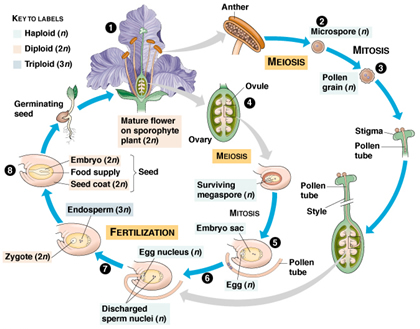
The word "angiosperm" comes from the Greek words for "vessel" and "seed" and translates roughly as "enclosed seed". In part, angiosperms (the flowering plants, phylumAnthophyta) are defined by the fact that their seeds are enclosed by an ovule. The life cycle of an angiospermis defined by the formation of the seed and its development to a full-grown plant which, in turn, produces seeds.

Angiosperms are vascular plants with flowers that produce seeds enclosed in an ovule—a fact that is recognized as the angiospermy condition.

Reproductive Flower Parts

In general, angiosperms have a floral axis with four floral parts, two of which are fertile. At the receptacle, or tip, of the axis there is an ovule-bearing leaf structure known as the carpel. The ovule or ovules can be found inside the pistil. Three portions compose the pistil: the ovary, the style, and the stigma, where the pollen usually germinates.

Angiosperm Plant Formation

Angiosperm Plant Formation

Angiosperms are flowering plants. Their formation entails development from embryo to seed, through germination to seedling, and finally to mature plant.

The life cycle of angiosperms (flowering plants) involves an alternation of generations between a dominant sporophytic (spore-producing) phase and a reduced gametophytic (gamete-producing) phase. The first cell of the sporophyte is the fertilized egg, or zygote, which undergoes repeated divisions, growth, and differentiation to form an embryo enclosed in the ovule.

After fertilization, the ovule is transformed into the seed, which germinates into a seedling. The seedling becomes the adult plant; the plant produces flowers inwhich the sperm and egg—representing, respectively, the male and female gametophytic generations—are formed. Fertilization occurs, and seeds are produced to continue the life cycle.

Angiosperms

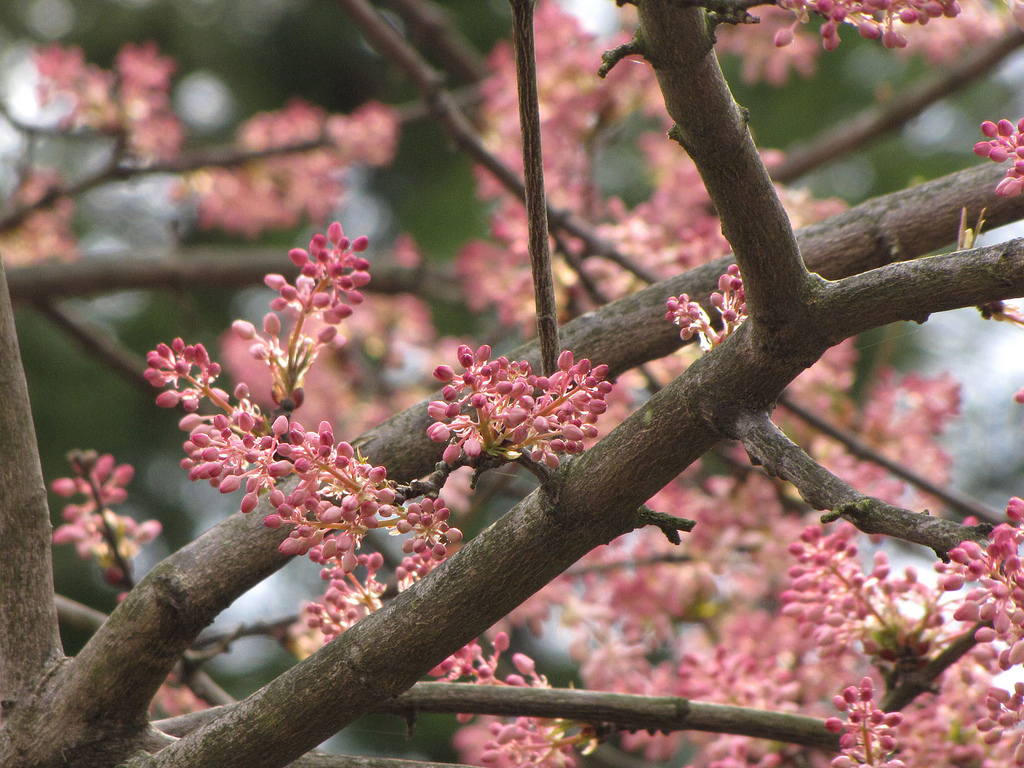
Angiosperms - Chinese Bladdernut Buds

The name "angiosperms" has long been used by botanists to refer to the flowering plants, a group of approximately 235,000 species. All angiosperms are members of the phylum Anthophyta.

The name "angiosperm" is actually derived from two Greekwords, angeion,meaning "vessel" or "container", and sperma, meaning "seed". The name was given in reference to the fact that the seeds of all flowering plants develop from ovules that are enclosed in a structure called a carpel.

This characteristic sets the angiosperms apart from all other plants, which either do not have seeds or have seeds that are not developed in structures resembling a carpel. Although the name angiosperm is used widely, plant taxonomists and many botanists typically refer to them by the more formal name Anthophyta, the phylum that contains the flowering plants.

Biochemical Coevolution in Angiosperms

Biochemical Coevolution in Angiosperms

Flowering plants, or angiosperms, produce many compounds that are not directly related to growth and development. These secondary metabolites arise from primary metabolic pathways and act as antiherbivory mechanisms, allelochemicals, or attractants.

Secondary metabolites are biochemicals produced by plants in response to selection pressures. These pressures may be from herbivory, competition, or the need for pollination.

As plants produce compounds to enhance their survival, predators, competitors, and pollinators react and evolve means of adjusting to the plant’s efforts. Chemically simple secondary metabolites may be widespread throughout angiosperm (flowering plant) families, whereas more complex chemicals are often restricted to a single species.

Bromeliaceae

Bromeliaceae
Bromeliaceae

The family Bromeliaceae comprises a group of perennial, monocotyledon herbs or trees that often age slowly.

Important ornamentals (called bromeliads) as well as sources of food and medicines, Bromeliaceae have substantial economic value and are widely cultivated. The colors of the leaves offer decorative foliage, and the flowers are of astonishing hues due to the rich content of pigment-forming substances known as anthocyanins.

Based on ovary position, habit, and floral and pollen morphology, the family Bromeliaceae has been split into three subfamilies: subfamily Pitcairnioideae, subfamily Tillandsioideae, and subfamily Bromelioideae.

Cacti and Succulents

Organ Pipe Cactus NM (AZ)... I've been there; I camped there with my wife; it was exhilarating! Sadly, the threat from illegal boarder crossings and drug trafficking will forever prohibit my return.
Wild cacti

Succulents are fleshy plants that store water in natural reservoirs such as stems or leaves. Cacti are a group of flowering plants; all cacti are succulents.

The Cactaceae family includes about 1,650 to 3,500 species of cacti and succulents classified in 130 genera. Because they live in harsh, arid environments, these fleshy, spiny perennial plants have developed a variety of unique characteristics for protection and to retain water, reduce evaporation, and resist heat.

Cacti

The word “succulent” is derived from the Latin term sucus, meaning sap. All cacti are succulents. The word “cactus” is derived from the Greek term kaktos, describing thistles. Botanists estimate cacti first existed during the Mesozoic era, about 130 million years ago. Limited cacti fossil evidence exists (the earliest known specimen is about forty thousand years old).

Compositae

Compositae
Compositae

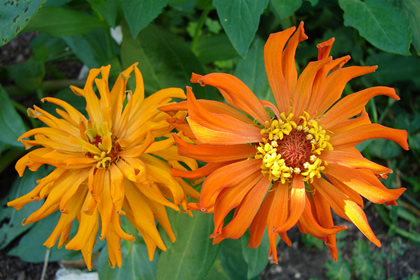
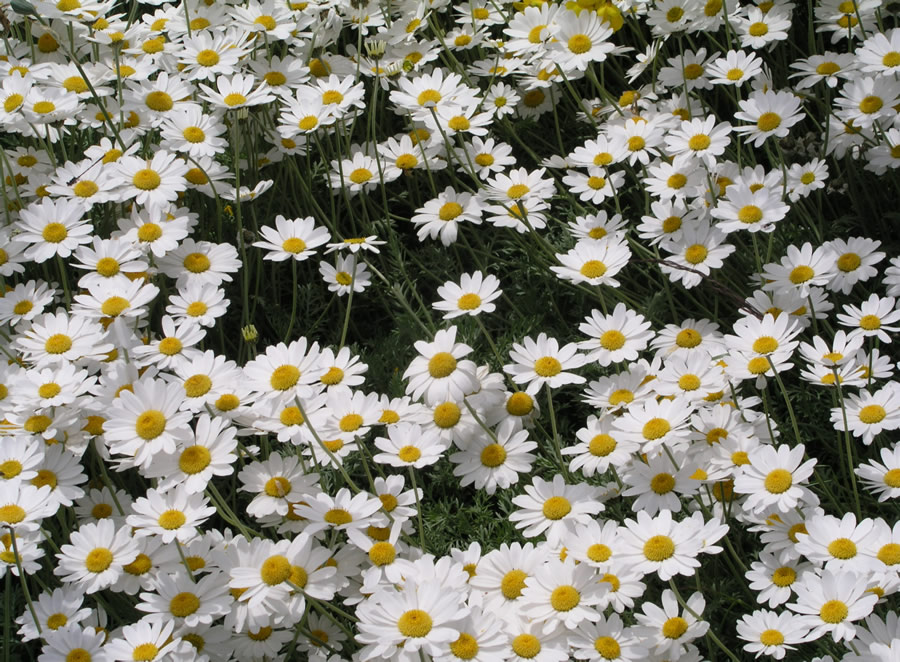
In number of species, the family Compositae or Asteraceae, commonly known as the sunflower family, is among the largest families of flowering plants.

The Compositae family consists of more than eleven hundred genera worldwide and possibly as many as twenty-three thousand species. Representatives of the family are found on every continent except Antarctica.

Species diversity is high in the southwestern United States and Mexico, in southern Brazil and along the South American Andes Mountain range, along the Mediterranean region, in Southwest and Central Asia, in South Africa, and in Australia.

Cycads and Palms

Cycads and Palms
Cycads and Palms

Members of the phylum Cycadophyta, cycads are descendants of giant, prehistoric seed-bearing, nonflowering plants that thrived when dinosaurs lived. Palms are flowering plants with primitive origins that share characteristics with cycads but are not related to them.

Cycadophyta is one of the four phyla of gymnosperms in the kingdom Plantae. At one time, cycads grew on every continent. Fossil cycads have been located in areas where no modern cycads grow, such as Antarctica and Europe, suggesting that those places once had milder temperatures.

Origins and Habitat

The oldest cycad fossils are 245 to 208 million years old, from the Triassic period. The first cycads are believed to have appeared in the Permian period 270 million years ago. Some botanists hypothesize that cycads originated as progymnosperms in the Devonian period about 408 million to 360 million years ago.

Eudicots

Eudicots
Eudicots

The eudicots, class Eudicotyledones (literally “true dicots”), are descended from a common ancestor and comprise three-quarters of all flowering plants. It is one of the two main classes of the angiosperms, the other being the monocots, or Monocotyledones.

Eudicots, the common name used for class Eudicotyledones, are the most common group of flowering plants, comprising 75 percent of all angiosperms. The other 25 percent, monocots (Monocotyledones), are often characterized by pollen grains that have a single aperture (or line of weakness).

Eudicots have pollen grains that typically possess three apertures, referred to as triaperturate pollen. Thus, there is no monocot-dicot division among the flowering plants.

Flower Structure

Blue flowers

Flowers are the modified shoots bearing modified leaves that serve as the sexual reproductive organs of angiosperms. This strategy for reproduction has been so successful that angiosperms now dominate the plant world, and accordingly there are many variations on the basic structure of a flower.

Flowers are organs of sexual reproduction produced by the angiosperms (phylum Anthophyta), the largest phylum of photosynthetic organisms, with roughly 250,000 species. This large number represents a great diversity of flower types, but all flowers have some common structural elements.

Flower Parts

Flowers are modified shoots bearing modified leaves. In the typical flower, the modified leaves can be grouped into four sets based on appearance and function: sepals, petals, stamens, and pistils. The sepals and petals are lowermost on the shoot toward the sides of the flower. The stamens and pistils are at the tip of the shoot at the inside.

Flower Types

Yellow hibiscus flower

The flower is the most distinctive feature of the phylum Anthophyta, commonly referred to as angiosperms or flowering plants, and is responsible in making them the most dominant, diverse, and widespread of all groups of plants.

There are already about 250,000 species of flowering plants that have been discovered and named. The basis for their diversity comes from their incredible reproductive success in a wide variety of habitats.

The success of this group is also reflected by the diversity of their flowers that show astonishing displays of different forms, sizes, shapes, and colors—all of these to lure pollinators and effect sexual reproduction.

Flowering Regulation

Flowering regulation

All flowering is regulated by the integration of environmental cues into an internal sequence of processes. These processes regulate the ability of plant organs to produce and respond to an array of signals. The numerous regulatory switches permit precise control over the time of flowering.

Control over the time of flowering is essential for the survival of flowering plants (angiosperms). Insect pollinators may be present only at certain times; unless an insect-pollinated plant is flowering at that time, pollination and the production of the next generation cannot occur.

Embryo and seed development may be successful only under certain climatic conditions. The ability to respond to environmental cues is an essential factor in the regulation of flowering.

Structure and Types of Fruit

Fruits
Fruits

Fruits are the seed-containing reproductive organs, including nuts and grains, produced by angiosperms (flowering plants).

When most people think of a fruit, what typically comes to mind is a juicy, edible object, such as an apple, orange, or banana. To botanists, however, fruit includes many plant-derived structures, such as grains, nuts, and many vegetables.

In essence, a fruit is an enlarge dovary, often with some accessory tissue, that develops after a flower has been pollinated. After pollination, seed development begins, and soon the peripheral parts of the flower fall away, leaving the immature fruit. The fruit subsequently enlarges and then ripens to maturity. It is then often edible.

Garden Plants: Flowering

Flower in the garden

The most popular flowering garden plants world wide include roses, lilies, tulips, irises, and daffodils. These plants range in form from herbs to bushes to trees. Their leaves, flowers, and optimum growth needs differ greatly.

Flowering plants (angiosperms) are grown in gardens for their beauty and their fragrant aromas. They and their relatives can also be grown for food. Myriad flowering plant types are grown in the world’s gardens.

Most popular flowering garden plants are in the rose family (Rosaceae, about three thousand species) and the lily family (Liliaceae, about forty-five hundred species), which together make up awide variety of herbs, bushes, and trees.

Garden Plants: Shrubs

Garden plants shrubs

Shrubs are perennial, woody plants that have multiple ecological uses and are economically important for a variety of landscape purposes. Like trees, the shrubs consist of both primary and secondary cambium (cells that ultimately form wood or bark), but unlike trees, shrubs typically have multiple stems and are somewhat shorter in height.

Native and nonnative shrubs have many uses, both in private gardens and as elements in commercial and civic landscaping. Shrubby willows and alders function as soil stabilizers, preventing erosion naturally along waterways. Other shrubs are natural wind breaks that reduce wind flow over open soils.

Farmers value shrubby wind breaks that preserve barren farm soils during fall and winter months,when the land is barren and topsoil is especially liable to be blown away during winter storms. For much the same reason, home owners may plant certain types of shrubs at strategic locations along the boundaries of the yard to reduce air flow.

Grasses and Bamboos

Grasses
Grasses

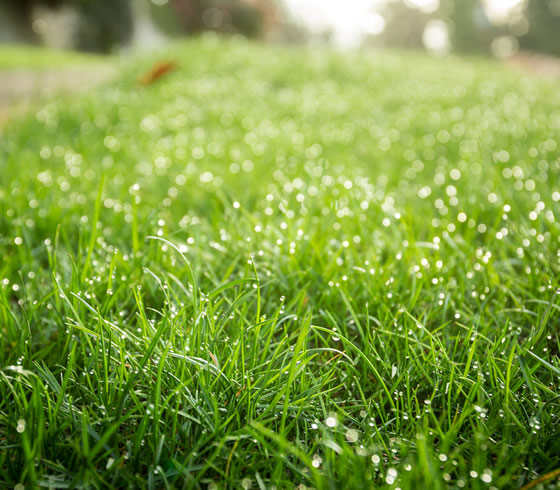
Grasses are monocotyledonous flowering plants (phylum Anthophyta, the angiosperms) belonging to the family Poaceae, formerly Gramineae. The family is widespread and economically very valuable. All the grasses are herbaceous except for the bamboos, some of which are treelike.

Grasses arose seventy million to eighty million years ago, in the Late Cretaceous period of the Mesozoic era. They succeeded partly because they concentrate their growth lower down on the leaf and stem than other plants do and thus can regenerate quickly when fire or herbivores remove the top part of the plant.

This makes them ideal for human uses such as lawns and pasture for domestic livestock. Grasses are a very important food source for humans. Grasses provide all cereal grains—barley, corn, millet, oats, rice, rye, and wheat. Other grasses used for food include sorghum, sugarcane, and bamboo.

Growth Habits

Growth Habits
Growth Habits

Plant habit, also known as plant life form, is the characteristic shape, appearance, or growth form of a plant species. It develops from specific genetic patterns of growth in combination with environmental factors and is part of the organization of every plant.

Growth of Plants

Development of a plant body is accomplished through growth, defined as increase in number of cells and size of a species. Rates of growth in plants are achieved in two ways: first, by geometric increase, in which all cells of the organism divide simultaneously, especially in a young embryonic plant; second, by arithmetic increase, in which only one cell undergoes division, especially in mature plants with localized growth in a region at the root and shoot apices.

Generally, plants grow by a combination of both kinds of cell division to produce variations of form that finally develop a specific habit that is unique to a particular plant species.

Halophytes

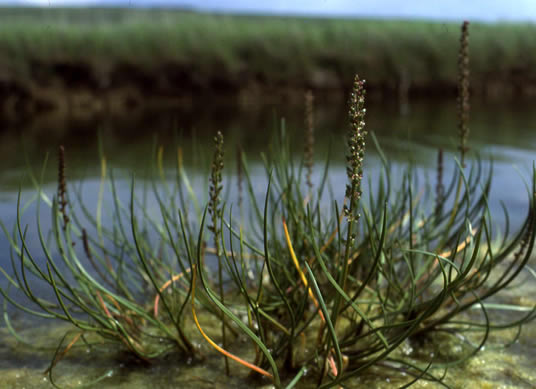
Halophytes: Sea Arrowgrass (Triglochin maritimum)

Halophytes are salt-resistant or salt-tolerant plants that thrive and complete their life cycles in soils or waters containing high salt concentrations. Despite high salt content in the tissues of halophytes, they can be grown and harvested as food or animal fodder.

The Salinity-Plant Relationship

Salts are ionic molecules that typically dissolve in water and split into cations (positively charged ions) and anions (negatively charged ions). Rain dissolves salts from minerals in rocks and soil.

These dissolved salts then either enter surface waters or percolate down to an aquifer. In arid regions where there is low rainfall, water evaporates quickly, leaving its salt load behind, leading to the development of saline soils, salt lakes, and brackish groundwater.