Showing posts with label physiology. Show all posts

Active Transport

Active Transport
Active Transport

Active transport is the process by which cells expend energy to move atoms or molecules across membranes, requiring the presence of a protein carrier, which is activated by ATP. Cotransport is active transport that uses a carrier that must simultaneously transport two substances in the same direction. Countertransport is active transport that employs a carrier that must transport two substances in opposite directions at the same time.

Biologists in nearly every field of study have discovered that one of the major methods by which organisms regulate their metabolisms is by controlling the movement of molecules into cells or into organelles such as the nucleus.

This regulation is possible because of the semipermeable nature of cellular membranes. The membranes of all living cells are fluid mosaic structures composed primarily of lipids and proteins. The lipid molecules are aliphatic, which means that their molecular structure exhibits both a hydrophilic (water-attracted) and a hydrophobic (water-repelling) portion.

Anaerobic Photosynthesis

Anaerobic photosynthesis, also known as anoxygenic photosynthesis, is the process by which certain bacteria use light energy to create organic compounds but do not produce oxygen. Anaerobes are those bacteria that cannot use oxygen to generate energy.

The photosynthetic process in all plants and algae, as well as in specific types of bacteria, involves the reduction of carbon dioxide to carbohydrate and the removal of electrons from water, resulting in the release of oxygen.

This process is known as oxygenic or aerobic photosynthesis. Water is oxidized by a multi-subunit protein located in the photosynthetic membrane. This is a molecular protein feature shared among more than 500,000 species of plants on earth.

While this is a common feature among nearly every form of plant life on earth, some photosynthetic bacteria can use light energy to extract electrons from molecules other than water. These bacteria are of ancient origin and are believed to have evolved before aerobic photosynthetic organisms.

Angiosperm Cells and Tissues

Angiosperm Cells and Tissues

Some cell types and tissues which are not found in any other groups of plants occur in angiosperms (flowering plants).

Angiosperms are a group of plants with seeds that develop within an ovary and reproductive organs in flowers. They are commonly referred to as flowering plants and represent the most successful group of plants on earth, with approximately 235,000 species.

Various cell types and tissues, many of which are not found in any other groups of plants, occur in angiosperms. These cells and tissues perform varied functions, which are very efficient compared to their counterparts in other plants. These include dermal, vascular (xylem and phloem), and ground tissues (such as parenchyma, collenchyma, and sclerenchyma).

Angiosperm Life Cycle

Angiosperm Life Cycle

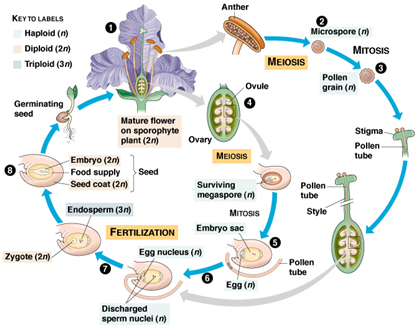
The word "angiosperm" comes from the Greek words for "vessel" and "seed" and translates roughly as "enclosed seed". In part, angiosperms (the flowering plants, phylumAnthophyta) are defined by the fact that their seeds are enclosed by an ovule. The life cycle of an angiospermis defined by the formation of the seed and its development to a full-grown plant which, in turn, produces seeds.

Angiosperms are vascular plants with flowers that produce seeds enclosed in an ovule—a fact that is recognized as the angiospermy condition.

Reproductive Flower Parts

In general, angiosperms have a floral axis with four floral parts, two of which are fertile. At the receptacle, or tip, of the axis there is an ovule-bearing leaf structure known as the carpel. The ovule or ovules can be found inside the pistil. Three portions compose the pistil: the ovary, the style, and the stigma, where the pollen usually germinates.

Angiosperm Plant Formation

Angiosperm Plant Formation

Angiosperms are flowering plants. Their formation entails development from embryo to seed, through germination to seedling, and finally to mature plant.

The life cycle of angiosperms (flowering plants) involves an alternation of generations between a dominant sporophytic (spore-producing) phase and a reduced gametophytic (gamete-producing) phase. The first cell of the sporophyte is the fertilized egg, or zygote, which undergoes repeated divisions, growth, and differentiation to form an embryo enclosed in the ovule.

After fertilization, the ovule is transformed into the seed, which germinates into a seedling. The seedling becomes the adult plant; the plant produces flowers inwhich the sperm and egg—representing, respectively, the male and female gametophytic generations—are formed. Fertilization occurs, and seeds are produced to continue the life cycle.

Biochemical Coevolution in Angiosperms

Biochemical Coevolution in Angiosperms

Flowering plants, or angiosperms, produce many compounds that are not directly related to growth and development. These secondary metabolites arise from primary metabolic pathways and act as antiherbivory mechanisms, allelochemicals, or attractants.

Secondary metabolites are biochemicals produced by plants in response to selection pressures. These pressures may be from herbivory, competition, or the need for pollination.

As plants produce compounds to enhance their survival, predators, competitors, and pollinators react and evolve means of adjusting to the plant’s efforts. Chemically simple secondary metabolites may be widespread throughout angiosperm (flowering plant) families, whereas more complex chemicals are often restricted to a single species.

Bioluminesence

Bioluminesence fungus

Bioluminesence is the production of light by living organisms, including algae and phytoplankton in the oceans and fungi on land.

Bioluminescence is a specific form of chemiluminescence in which the chemical energy that is produced in a chemical reaction is converted into radiant energy. In bioluminescence the reaction originates in a wide variety of living organisms, including a small number of plants. It should not be confused with fluorescence or phosphorescence, both of which do not involve a chemical reaction.

In either of the former cases the energy from a source of light, not from a chemical reaction, is basically absorbed and then re-emitted in some form of another photon. The chemical reactions that lead to bioluminescence release energy in the form of light.

Bulbs and Rhizomes

Bulbs and rhizomes are modified stems, stem bases, or other underground organs used by plants for food (or energy) storage and in asexual reproduction.

Plants reproduce both sexually and asexually. Although sexual reproduction is part of the typical life cycle of plants, for a variety of reasons a plant may reproduce asexually. Exact duplicates of a plant, called clones, are formed by asexual reproduction.

Asexual Reproduction

Asexual reproduction involves the production of offspring through the formation of propagules by mitosis (the process of nuclear cell division). Because genetic recombination does not occur in mitosis, the offspring are genetically identical to the parent plant.

Asexual reproduction does not occur in all plants; some reproduce asexually only when humans intervene. Asexual reproduction occurs when a single plant produces a vegetative propagule that develops into a separate free-living plant. Many of the propagules that support asexual reproduction are actually highly modified branches. Others are modified roots.

C4 and CAM Photosynthesis


Alternative forms of photosynthesis are used by specific types of plants, called C4 and CAM plants, to alleviate problems of photorespiration and excess water loss.

Photosynthesis is the physiological process whereby plants use the sun’s radiant energy to produce organic molecules. The backbone of all such organic compounds is a skeleton composed of carbon atoms. Plants use carbon dioxide from the atmosphere as their carbon source.

The overwhelming majority of plants use a single chemical reaction to attach carbon dioxide from the atmosphere onto an organic compound, a process referred to as carbon fixation. This process takes place inside specialized structures within the cells of green plants known as chloroplasts.

Calvin cycle

Calvin cycle
Calvin cycle
The Calvin cycle is the principal mechanism that leads to the conversion of carbon dioxide into sugars by plants, algae, photosynthetic bacteria, and certain other bacteria that use chemicals as an energy source instead of light.

The Calvin cycle, also known as the Calvin Benson cycle, is an integral part of the process of photosynthesis in plants, algae, and photosynthetic bacteria. Named after its discoverer, Melvin Calvin of the University of California at Berkeley, its principal product is a three-carbon compound called glyceraldehyde 3-phosphate, or PGAL. Sugars are synthesized using PGAL as a starting material.

Light, absorbed by chlorophyll, is used to synthesize the high-energy compounds adenosine triphosphate (ATP) and reduced nicotinamide adenine dinucleotide phosphate (NADPH). Chlorophyll and the enzymes that are used for synthesis of ATP and NADPH are associated with internal membranes in all photosynthetic cells.

The ATP and NADPH, once formed, are released from the membrane-bound enzymes and diffuse into the surrounding solution inside the cell. The Calvin cycle takes place in this solution, using the ATP and NADPH molecules as a source of energy to drive the conversion of carbon dioxide into PGAL.

Cell Cycle

Cell Cycle
Cell Cycle

In plants, as in all eukaryotic life-forms, the cell cycle comprises the processes of cell division, constituted by three preparatory phases (G , G , and S), followed by mitosis (nuclear division) and cytokinesis (cytoplasm division).

One of the fundamental characteristics of living organisms is their ability to grow and reproduce. At the cellular level, growth is accomplished by a gain of mass, followed by division into two daughter cells.

In unicellular species, such as bacteria and green algae, this division results in the production of new organisms. In multicellular organisms, such as plants, cells must divide many times to produce new individuals, and additional processes of differentiation into mature cell types must occur.

Cell Theory


The notion that the cell is the smallest division of life and its attendant principles have been developed over the past three centuries and are collectively known as the cell theory.

Before the invention of the microscope, people studying living organisms saw whole and complete organisms and did not imagine that life was subdivided into smaller compartments. It is now known that the cell is the fundamental unit of life and that all living organisms are composed of cells. Because cells are microscopic, their existence was not discovered until the seventeenth century.

Discovery of the Cell

The discovery of the cell did not come about until the last half of the seventeenth century, after the Dutch inventor Antoni van Leeuwenhoek built the first light microscope. When looking at pond water using his light microscope in 1674, Leeuwenhoek saw many tiny creatures which were invisible to the naked eye. Leeuwenhoek assumed that these tiny “animalcules” were alive because he could see them moving.

Cell Wall

Cell Wall

The cell wall is the outer, rigid wall of a cell, dividing the protoplast (the interior, including the cytoplasm and nucleus) from the cell’s external environment. The plant cell wall is both unique to and a major feature of plants, perhaps second only to the plant’s photosynthetic ability.

The primary functions of the cell wall in plant cells include are to provide protection for the enclosed cytoplasm and give mechanical support to the entire plant structure. Plant cell walls are part of the extracellular matrix, a complex mixture of extracellular materials found between cells.

These materials are synthesized by the intracellular contents and transported through the plasma membranes. All plant cell types consist of at least a primary cell wall, and many also produce a secondary cell wall. In addition, certain cells also secrete specialized substances into the extracellular matrix.

Chloroplasts and Other Plastids

Plant cell chloroplast structure

Plastids are highly specialized, double membrane-bound organelles found within the cells of all plants and algae. A type of plastid called the chloroplast is the cellular location of the process of photosynthesis.

Plastids exhibit remarkable diversity with respect to their development, morphology, function, and physiological and genetic regulation. Chloroplasts, a type of plastid, are arguably largely responsible for the maintenance and perpetuation of most of the major life-forms on earth through photosynthesis.

The process of photosynthesis uses visible light as an energy source to power the conversion of atmospheric carbon dioxide into organic molecules that can be used by living organisms.

Circadian Rhythms

Circadian Rhythms
Circadian Rhythms

Circadian rhythms in plants are phases of growth and activity that appear in regular, approximately twenty-four-hour, cycles.

Biological activities that cycle in approximately twenty-four-hour intervals are called circadian rhythms (from the Latin circa, meaning “about” and dies, meaning “a day”). Circadian rhythms allow plants to anticipate environmental cycles and to coordinate their activities with them.

Circadian rhythms are not simply responses to changing external conditions, as they continue even when a plant is placed under constant conditions. This continuation indicates that circadian rhythms are controlled by endogenous (internal) timing mechanisms, collectively referred to as the biological clock.

Dormancy

Plant dormancy
Plant dormancy

Dormancy is the state in which a plant or plant part exhibits little or no growth and in which most, if not all, metabolic activity ceases for a period of time.

The vast majority of plant life functions best when there is ample water and temperatures are well above freezing throughout the year. Except for those in moist, tropical regions, however, plants are exposed to dry periods and temperatures below freezing for varying lengths of time during the year. Plants, unlike animals, do not have the luxury of body insulation or locomotion.

Hence, plants cannot seek shelter or use other active ways to survive water shortages and cold weather. Consequently, many plants become dormant to avoid unfavorable environmental conditions. In dormancy, their metabolic activity either ceases or is drastically reduced.

Endocytosis and Exocytosis

Endocytosis and Exocytosis

Endocytosis is used by cells to move water, macro molecules, or larger objects, such as cell fragments or even whole cells, from outside a cell to the inside of the cell. Exocytosis is the reverse of endocytosis, that is, the movement of materials from the inside to the outside of the cell. Both types of transport move the materials using membrane-bound vesicles.

Endocytosis

In endocytosis, during which materials are moved into a cell, the cell’s plasma membrane engulfs material and packs it into saclike structures called vesicles. The vesicles then detach from the plasma membrane and move into the cell.

Once the vesicle is in the cytoplasm, it will typically fuse with some other membrane-bound organelle, such as a vacuole or the endoplasmic reticulum, and release its contents into the organelle. There are three types of endocytosis: phagocytosis (transport of actual particles), pinocytosis (transport of water, along with any solutes in the water), and receptor-mediated endocytosis (explained in detail below).

Energy flow in plant cells

Transformation of sunlight into biochemical energy

Life on earth is dependent on the flow of energy from the sun. A small portion of the solar energy, captured in the process of photosynthesis, drives many chemical reactions associated with living systems.

In living organisms, energy flows through chemical reactions. Each chemical reaction converts one set of substances, called the reactants, into another set, the products.

All chemical reactions are essentially energy transformations, in which energy stored in chemical bonds is transferred to other, newly formed chemical bonds. Exergonic reactions release energy, whereas endergonic reactions require an input of energy for a reaction to occur.

Flowering Regulation

Flowering regulation

All flowering is regulated by the integration of environmental cues into an internal sequence of processes. These processes regulate the ability of plant organs to produce and respond to an array of signals. The numerous regulatory switches permit precise control over the time of flowering.

Control over the time of flowering is essential for the survival of flowering plants (angiosperms). Insect pollinators may be present only at certain times; unless an insect-pollinated plant is flowering at that time, pollination and the production of the next generation cannot occur.

Embryo and seed development may be successful only under certain climatic conditions. The ability to respond to environmental cues is an essential factor in the regulation of flowering.

Gas Exchange in Plants

Gas exchange in plants

Gas exchange is the process whereby water vapor and oxygen leave and carbon dioxide enters plant leaves. The gaseous balance in plants is quite complex because plant cells carry on both respiration and photosynthesis.

All living organisms continually produce gases via metabolic and cellular activities, and the vast majority of living things are in one way or another in intimate contact with a gaseous medium.

In most instances, therefore, there is ample opportunity for all organisms to exchange gases with the environment. The gaseous balance in plants is quite complex because plant cells carry on both respiration and photosynthesis.