Showing posts with label nutrients and nutrition. Show all posts

Biofertilizers

Biofertilizers
Biofertilizers
The use of biofertilizers, biological systems that supply plant nutrients such as nitrogen to agricultural crops, could reduce agriculture’s dependency on chemical fertilizers, which are often detrimental to the environment.

Plants require an adequate supply of the thirteen mineral nutrients necessary for normal growth and reproduction. These nutrients, which must be supplied by the soil, include both macronutrients (nutrients required in large quantities) and micronutrients (nutrients required in smaller quantities). As plants grow and develop, they remove these essential mineral nutrients from the soil.

Because normal crop production usually requires the removal of plants or plant parts, the nutrients are continuously removed from the soil. Therefore, the long-term agricultural utilization of any soil requires periodic fertilization to replace lost nutrients.

Nitrogen is the plant nutrient that is most often depleted in agricultural soils, and most crops respond to the addition of nitrogen fertilizer by increasing their growth and yield. Therefore, more nitrogen is applied to cropland than any other fertilizer component.

Carbohydrates


Common organic chemicals found in all living organisms, important in energy metabolism and structural polymers, carbohydrate molecules are made up of carbon, hydrogen, and oxygen.

Carbohydrates are made of carbon, hydrogen, and oxygen molecules in a 1:2:1 ratio, respectively. This is often simplified using the formula nCH2O, where n represents the number of CH2O subunits in a carbohydrate. This formula should make it clear how the name carbohydrate was derived, as nCH2O is essentially carbon and water.

The simplest carbohydrates are the monosaccharides, or simple sugars. Individual monosaccharides can be joined together to make disaccharides (composed of two monosaccharides), oligosaccharides (short polymers composed of two to several monosaccharides), and polysaccharides (longer polymers composed of numerous monosaccharides).

Fertilizers

Fertilizers
Fertilizers

Fertilizers are materials used to modify the chemical composition of soil in order to enhance plant growth. They represent an important use of natural resources because agricultural systems depend upon an ability to retain soil fertility.

Soil is a dynamic, chemically reactive medium, and agricultural soils must provide structural support for plants, contain a sufficient supply of plant nutrients, and exhibit an adequate capacity to hold and exchange minerals.

Topsoil, the 6-inch layer of soil covering the earth’s landmasses, is the root zone for the majority of the world’s food and fiber crops. As plants grow and develop, they remove the essential mineral nutrients from the soil. Because crop production normally requires the removal of plants or plant parts, nutrients are continuously being removed from the soil.

Food Chain

Food Chain

The food chain concept allows ecologists to interconnect the organisms living in an ecosystem and to trace mathematically the flow of energy from plants through animals to decomposers.

The food chain concept provides the basic framework for production biology and has major implications for agriculture, wildlife biology, and calculating the maximum amount of life that can be supported on the earth. As early as 1789, naturalists such as Gilbert White described the many sequences of animals eating plants and themselves being eaten by other animals.

However, the use of the term “food chain” dates from 1927, when Charles Elton described the implications of the food chain and food web concept in a clear manner. His solid exposition advanced the study of two important biological concepts: the complex organization and interrelatedness of nature, and energy flow through ecosystems.

Microbial Nutrition and Metabolism

Microbial Nutrition and Metabolism

The diverse metabolic activities of microorganisms make them a critical component of all the earth’s ecosystems and a source of many useful products for human industry.

Microorganisms—bacteria, fungi, algae, and protists—are found in every environment on the earth that supports life. Microorganisms have been found in hot springs where temperatures exceed 80 degrees Celsius as well as in rocks of Antarctic deserts.

To ensure survival in a variety of habitats, microorganisms have developed a fascinating variety of strategies for survival. The study of microbial ecology involves consideration of the mechanisms employed by microorganisms to obtain nutrients and energy from their environment.

Nitrogen Cycle

Nitrogen Cycle
Nitrogen Cycle

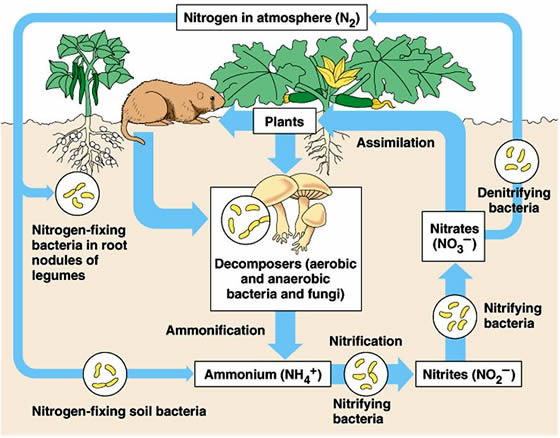
The nitrogen cycle outlines the movement of the element nitrogen from one chemical state to another as it makes its way through a series of complex physical and biological interactions.

Nitrogen (N) is one of the most dynamic elements in the earth’s biosphere; it undergoes transformations that constantly convert it between organic, inorganic, gaseous, and mineral forms.

Nitrogen is an essential element in all living things, where it is a crucial component of organic molecules such as proteins and nucleic acids. Consequently, nitrogen is in high demand in biological systems.

Nutrient cycling

Nutrient cycling
Nutrient cycling

Within an ecosystem, nutrients move through biogeochemical cycles. Those cycles involve chemical exchanges of elements among the earth’s atmosphere, water, living organisms, soil, and rocks.

All biogeochemical cycles have a common structure, sharing three basic components: inputs, internal cycling, and outputs.

Input of Nutrients

The input of nutrients to an ecosystem depends on the type of biogeochemical cycle. Nutrients with a gaseous cycle, such as carbon and nitrogen, enter an ecosystem from the atmosphere. For example, carbon enters ecosystems almost solely through photosynthesis, which converts carbon dioxide to organic carbon compounds.

Nutrients

nutrient

Plant nutrients are the molecular compounds necessary to maintain plant life.

Plants, like animals and other forms of life, require a great diversity of compounds. Molecules of these compounds are used to build and maintain cells and to perform other necessary life processes, such as growth and reproduction, as well as respiration and photosynthesis.

Plants manufacture, by the process of photosynthesis, simple sugars. From these are formed polysaccharides (starches, cellulose) and, eventually, a variety of lipids (fats, oils, and waxes), hundreds of different protein molecules, and many other organic compounds.

Nutrition in Agriculture

Nutrition in Agriculture

Extensive research has been conducted to investigate the nutritional requirements of different crops and ways to enhance soil fertility, which has greatly benefited agricultural production.

Even though people have known for more than two thousand years that adding mineral elements, such as plant ash or lime, to the soils can improve plant growth, the systematic study of plant nutrition is a relatively young science, considering humanity’s long history of cultivating crops. About 250 years ago, farmers and gardeners started to ask the question, “What makes plants grow?”

It was widely believed that soil humus, a brown or black organic substance resulting from the partial decay of plant and animal matter, provided plants with carbon for making sugar and starch, and substances such as saltpeter, lime, and phosphates simply helped the humus to be more useful.

Phosphorus Cycle

Phosphorus Cycle
Phosphorus Cycle

The constant exchange of a mineral or elemental nutrient between organisms and the physical environment is called a biogeochemical cycle. Along with the carbon cycle and the oxygen cycle, one of the most important biogeochemical cycles is that of the element phosphorus.

The phosphorus cycle involves the movement of the element phosphorus as it circulates through the living and nonliving portions of the biosphere.

Many of the chemical elements found on the earth are vital to the processes and systems of living organisms. Unlike oxygen and carbon, phosphorus follows complex pathways. It circulates through the earth’s soils, rocks, waters, and atmosphere and through the organisms that inhabit these many ecosystems.

Soil

Soil is a product of the physical and chemical breakdown of the earth’s surface into small fragments, including sand, silt, and clay. Soil contains the products of organic matter decomposition—the composting of dead plant and animal debris.

Soils are classified on the basis of soil profile and soil formation. They can be grouped according to a number of characteristics, including agronomic use, color, organic matter content, texture, and moisture condition.

Typical soil is about 45 percent minerals and about 5 percent organic matter. The other 50 percent of soil consists of pores that hold either water or air. The liquid portion of soil contains dissolved minerals and organic compounds, produced by plants and microorganisms.

Sugars

Sugar

Refined from sugarcane, sugar beets, and corn, sugars are a major and vital part of nutrition and provide the basic molecular structure for most living matter.

Sugars, through the process called cellular respiration, are the primary power sources used to produce adenosine triphosphate (ATP), the energy exchange molecule that sustains all life.

Energy is stored in organisms as starch or fat but is burned as sugar. Sugars include some of the simplest carbohydrates, and they are building blocks of more complicated molecules. Common sugars include glucose, fructose, sucrose, maltose, and lactose.