Garden Plants: Flowering

Flower in the garden

The most popular flowering garden plants world wide include roses, lilies, tulips, irises, and daffodils. These plants range in form from herbs to bushes to trees. Their leaves, flowers, and optimum growth needs differ greatly.

Flowering plants (angiosperms) are grown in gardens for their beauty and their fragrant aromas. They and their relatives can also be grown for food. Myriad flowering plant types are grown in the world’s gardens.

Most popular flowering garden plants are in the rose family (Rosaceae, about three thousand species) and the lily family (Liliaceae, about forty-five hundred species), which together make up awide variety of herbs, bushes, and trees.

Garden Plants: Shrubs

Garden plants shrubs

Shrubs are perennial, woody plants that have multiple ecological uses and are economically important for a variety of landscape purposes. Like trees, the shrubs consist of both primary and secondary cambium (cells that ultimately form wood or bark), but unlike trees, shrubs typically have multiple stems and are somewhat shorter in height.

Native and nonnative shrubs have many uses, both in private gardens and as elements in commercial and civic landscaping. Shrubby willows and alders function as soil stabilizers, preventing erosion naturally along waterways. Other shrubs are natural wind breaks that reduce wind flow over open soils.

Farmers value shrubby wind breaks that preserve barren farm soils during fall and winter months,when the land is barren and topsoil is especially liable to be blown away during winter storms. For much the same reason, home owners may plant certain types of shrubs at strategic locations along the boundaries of the yard to reduce air flow.

Gas Exchange in Plants

Gas exchange in plants

Gas exchange is the process whereby water vapor and oxygen leave and carbon dioxide enters plant leaves. The gaseous balance in plants is quite complex because plant cells carry on both respiration and photosynthesis.

All living organisms continually produce gases via metabolic and cellular activities, and the vast majority of living things are in one way or another in intimate contact with a gaseous medium.

In most instances, therefore, there is ample opportunity for all organisms to exchange gases with the environment. The gaseous balance in plants is quite complex because plant cells carry on both respiration and photosynthesis.

Gene Flow

Gene flow

Gene flow represents a recurrent exchange of genes between populations. This exchange results when immigrants from one population interbreed with members of another.

Charles Darwin published On the Origin of Species by Means of Natural Selection in 1859. Since then, scientists have modified and added new concepts to the theory of evolution by natural selection. One of those concepts, which was only dimly understood in Darwin’s lifetime, is the importance of genetics in evolution, especially the concepts of migration and gene flow.

Genes

Genes are elements within the cells of a living organism that control the transmission of hereditary characteristics by specifying the structure of a particular protein or by controlling the function of other genetic material. Within any species, the exchange of genes via reproduction is constant among its members, ensuring genetic similarity.

Gene Regulation

Gene regulation

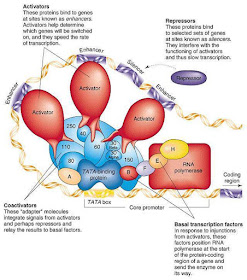
Genetic regulation is the manner in which a cell carries out transcription of its DNA (by copying it to messenger RNA) and the production of corresponding protein, called translation.

When a gene is expressed, one strand of that gene’s double helical deoxyribonucleic acid (DNA) is copied, in the process of transcription, by an enzyme called RNA(ribonucleic acid) polymerase to make a messenger RNA (mRNA).

The mRNA then associates with a ribosome (formed by specific ribosomal RNAs and proteins), where the nucleic acid base sequence is read, to produce the corresponding protein in a process called translation.

Genetic Code

Genetic code

The genetic code defines each amino acid in a protein, or polypeptide, in terms of a specific sequence of three nucleotide called codons, in the DNA. The genetic code is therefore the key to converting the information contained in genes int proteins.

The genetic code defines each amino acid in a protein, or polypeptide, in terms of a specific sequence of three nucleotides, called codons, in the deoxyribonucleic acid (DNA). Therefore, the genetic code is called a triplet code.

The four different nucleotides in DNA can form sixty-four different triplet codons. Because there are only twenty amino acids found in proteins, some amino acids are encoded by more than one codon. Therefore, the genetic code is said to be redundant, or degenerate.

Genetic Drift

Genetic Drift

Genetic drift refers to random changes in the genetic composition of a population. It is one of the evolutionary forces that cause biological evolution, the others being selection, mutation, and migration, or gene flow.

Drift occurs because the genetic variants, or alleles, present in a population are a random sample of the alleles that adults in the previous generation would have been predicted to pass on, where predictions are based on expected migration rates, expected mutation rates, and the direct effects of alleles on fitness.

If this sample is small, then the genetic composition of the offspring population may deviate substantially from expectation, just by chance. This deviation is called genetic drift.