Showing posts with label movement. Show all posts

Circadian Rhythms

Circadian Rhythms
Circadian Rhythms

Circadian rhythms in plants are phases of growth and activity that appear in regular, approximately twenty-four-hour, cycles.

Biological activities that cycle in approximately twenty-four-hour intervals are called circadian rhythms (from the Latin circa, meaning “about” and dies, meaning “a day”). Circadian rhythms allow plants to anticipate environmental cycles and to coordinate their activities with them.

Circadian rhythms are not simply responses to changing external conditions, as they continue even when a plant is placed under constant conditions. This continuation indicates that circadian rhythms are controlled by endogenous (internal) timing mechanisms, collectively referred to as the biological clock.

Heliotropism

Heliotropism
Heliotropism

Heliotropism is a growth movement in plants that is induced by sunlight. It is sometimes called solar tracking, a directional response to the sun. Because plants react in a similar way toward artificial sources of light, heliotropism is sometimes termed phototropism, a growth movement induced by any light stimulus.

Plants that orient their leaves to receive maximum sunlight are called diaheliotropic. Diaheliotropism is the tendency of leaves or other organs of a plant to track the sun by turning their surfaces toward it. Tracking the sun maximizes the amount of direct solar radiation received. Diaheliotropic movements can increase radiation interception, enhance photosynthesis, and increase growth rates of plants.

Plants that move their leaves to avoid sunlight are called paraheliotropic. Paraheliotropism is a plant response to minimize surface exposure to the sun. By orienting leaves and other plant organs parallel to the sun’s rays, light absorption is minimized. It is a process that some plants use to reduce dehydration by reducing leaf temperatures and water loss during times of drought.

Nastic Movements

Nastic movements
Nastic movements

Plants, unlike animals, are sedentary organisms, but they are capable of some limited movements. These include nastic movements, which enable plants to adapt rapidly to changes in their environment by changing orientation.

Nastic movements and tropisms, or growth movements, are two important, but different, kinds of movements in plants. In nastic movements, the direction of movement is determined by the anatomy of the plant rather than by the position of the origin of the stimulus.

In tropisms, the movement is in a direction either toward or away from the origin of the stimulus. In addition, the orientational changes that occur in nastic movements are temporary; they are reversible and repeatable. The tropisms, in contrast, are generally irreversible.

Thigmomorphogenesis

Checking thigmomorphogenesis efect on crops

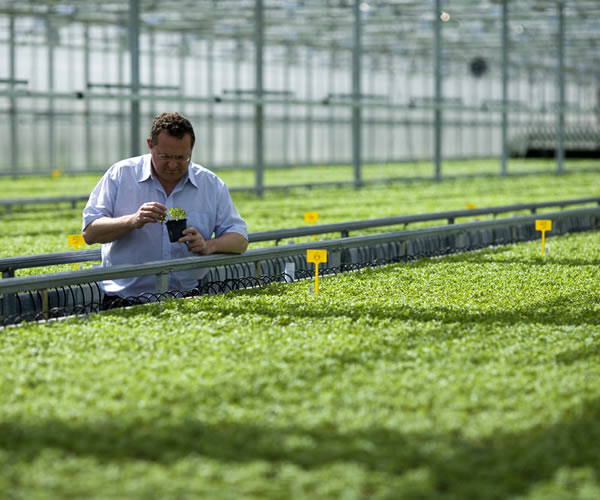
Thigmomorphogenesis refers to the influence of mechanical stimuli on plant growth and development. Many plants respond to stimuli such as wind or touch, intentionally by human beings or unintentionally by farm machineries and animals.

Plants subjected to thigmomorphogenesis, or physical disturbances such as wind and touch, generally respond through reduction in the rate of stem elongation and shoot height, and they increase in stem diameter. All of these features result in the formation of short, stocky plants.

This response is purely adaptive and allows individual plants to compensate for the different levels of stress that occur in their natural environment. The advantage of this is that shorter and stronger plants are less easily damaged by natural mechanical stresses (especially wind) than their taller, more slender counterparts.

Tropisms

Tropisms
Tropisms

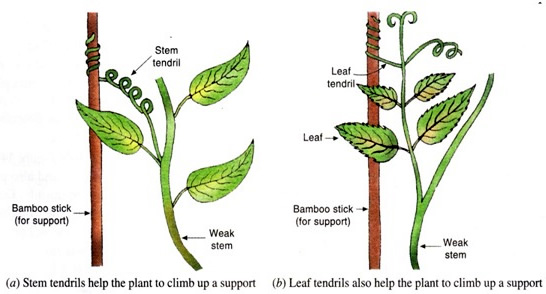
Tropisms are the means by which plants grow toward or away from environmental stimuli such as light, gravity, objects to climb, moisture in soil, or the position of the sun.

Although plants appear not to move, they have evolved adaptations to allow movement in response to various environmental stimuli; such mechanisms are called tropisms.

There are several kinds of tropism, each of which is named for the stimulus that causes the response. For example, gravitropism is a growth response to gravity, and phototropism is a growth response to unidirectional light.