Showing posts with label biogeochemical cycles. Show all posts

Calvin cycle

Calvin cycle
Calvin cycle
The Calvin cycle is the principal mechanism that leads to the conversion of carbon dioxide into sugars by plants, algae, photosynthetic bacteria, and certain other bacteria that use chemicals as an energy source instead of light.

The Calvin cycle, also known as the Calvin Benson cycle, is an integral part of the process of photosynthesis in plants, algae, and photosynthetic bacteria. Named after its discoverer, Melvin Calvin of the University of California at Berkeley, its principal product is a three-carbon compound called glyceraldehyde 3-phosphate, or PGAL. Sugars are synthesized using PGAL as a starting material.

Light, absorbed by chlorophyll, is used to synthesize the high-energy compounds adenosine triphosphate (ATP) and reduced nicotinamide adenine dinucleotide phosphate (NADPH). Chlorophyll and the enzymes that are used for synthesis of ATP and NADPH are associated with internal membranes in all photosynthetic cells.

The ATP and NADPH, once formed, are released from the membrane-bound enzymes and diffuse into the surrounding solution inside the cell. The Calvin cycle takes place in this solution, using the ATP and NADPH molecules as a source of energy to drive the conversion of carbon dioxide into PGAL.
Carbon Cycle

Carbon Cycle
Carbon Cycle

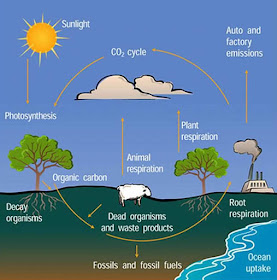
The carbon cycle is the movement of the element carbon through the earth’s rock and sediment, the aquatic environment, land environments, and the atmosphere. Large amounts of organic carbon can be found in both living organisms and dead organic material.

An enormous reservoir of carbon, on the order of 20 x 1015 tons, may be found on the surface of the earth. Most of this reservoir is found in rock and sediment. The carbon cycle therefore represents the movement of this element through the biosphere in a process mediated by photosynthetic plants on land and in the sea.

The process involves the fixation of carbon dioxide (CO2) into organic molecules, a process called photosynthesis. Energy used in the process is stored in chemical form, such as that in carbohydrates (sugars such as glucose). The organic material is eventually oxidized, as occurs when a photosynthetic organism dies.

Hydrologic Cycle

hydrologic cycle
hydrologic cycle

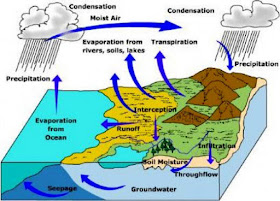
The hydrologic cycle is a continuous system through which water circulates through vegetation, in the atmosphere, in the ground, on land, and in surface water such as rivers and oceans.

The sun and the force of gravity provide the energy to drive the cycle that provides clean, pure water at the earth’s surface. The total amount of water on earth is an estimated 1.36 billion cubic kilometers. Of this water, 97.2 percent is found in the earth’s oceans. The ice caps and glaciers contain 2.15 percent of the earth’s water.

The remainder, 0.65 percent, is divided among rivers (0.0001 percent), freshwater and saline lakes (0.017 percent), groundwater (0.61 percent), soil moisture (0.005 percent), the atmosphere (0.001 percent), and the biosphere and groundwater below 4,000 meters (0.0169 percent). While the percentages of water appear to be small for these water reservoirs, the total volume of water contained in each is immense.

Nitrogen Cycle

Nitrogen Cycle
Nitrogen Cycle

The nitrogen cycle outlines the movement of the element nitrogen from one chemical state to another as it makes its way through a series of complex physical and biological interactions.

Nitrogen (N) is one of the most dynamic elements in the earth’s biosphere; it undergoes transformations that constantly convert it between organic, inorganic, gaseous, and mineral forms.

Nitrogen is an essential element in all living things, where it is a crucial component of organic molecules such as proteins and nucleic acids. Consequently, nitrogen is in high demand in biological systems.

Nutrient cycling

Nutrient cycling
Nutrient cycling

Within an ecosystem, nutrients move through biogeochemical cycles. Those cycles involve chemical exchanges of elements among the earth’s atmosphere, water, living organisms, soil, and rocks.

All biogeochemical cycles have a common structure, sharing three basic components: inputs, internal cycling, and outputs.

Input of Nutrients

The input of nutrients to an ecosystem depends on the type of biogeochemical cycle. Nutrients with a gaseous cycle, such as carbon and nitrogen, enter an ecosystem from the atmosphere. For example, carbon enters ecosystems almost solely through photosynthesis, which converts carbon dioxide to organic carbon compounds.

Phosphorus Cycle

Phosphorus Cycle
Phosphorus Cycle

The constant exchange of a mineral or elemental nutrient between organisms and the physical environment is called a biogeochemical cycle. Along with the carbon cycle and the oxygen cycle, one of the most important biogeochemical cycles is that of the element phosphorus.

The phosphorus cycle involves the movement of the element phosphorus as it circulates through the living and nonliving portions of the biosphere.

Many of the chemical elements found on the earth are vital to the processes and systems of living organisms. Unlike oxygen and carbon, phosphorus follows complex pathways. It circulates through the earth’s soils, rocks, waters, and atmosphere and through the organisms that inhabit these many ecosystems.